loading
HireEliteDigitalExpertsInstantly
loading
AI Design
Generative interfaces are no longer a concept — they are the new standard for AI-powered products. Here's what adaptive AI design means, why it matters, and how your SaaS product can benefit right now.
Strategic Insights Group
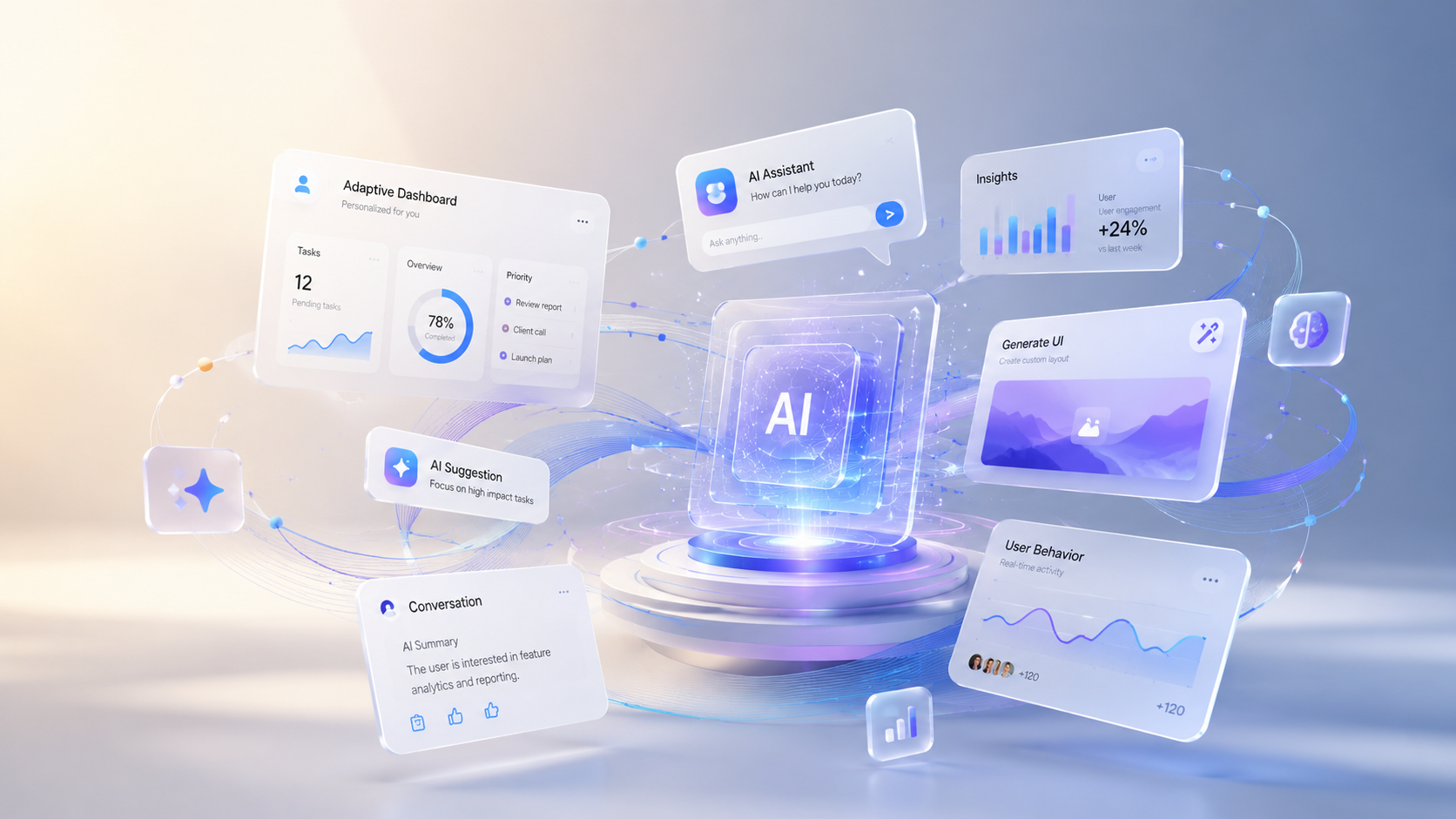
Adaptive AI design refers to a new generation of product interfaces that change, personalize, and respond dynamically based on user behavior, intent signals, and the outputs of generative AI models. Unlike traditional static UI — where every user sees the same buttons, menus, and layouts — an adaptive interface learns and evolves, making each user's experience uniquely relevant to them.
At its core, adaptive AI design merges two disciplines: user experience design and AI model development. The result is a product surface that doesn't just display information — it anticipates needs, surfaces the right actions, and restructures itself in real time to serve the user's current goal.
For SaaS companies and AI tool builders in 2025, this is no longer optional. As generative AI capabilities become commoditized, the produc experience layer — the interface — becomes the primary differentiator.
ARTICLE SECTIONS
Lead Product Designer
Get the latest technical insights delivered weekly to your inbox.
| Object | Metric Improment |
|---|---|
| Faster onboarding | Up to 3x faster |
| Feature discovery | 67% increase |
| Support tickets | 38% fewer |
| User retention | 62% higher |
The future of AI design is not about more buttons, better color palettes, or smoother animations. It is about interfaces that think — that understand who is using them, what they are trying to accomplish, and how to help them get there faster and more confidently than any static design ever could.
Adaptive AI design and generative interfaces represent the next fundamental shift in how software is experienced. For teams building AI-powered products, the question is no longer whether to adopt adaptive design — it is how quickly and how intelligently you can make the transition.
The products that win the next decade will not be the ones with the most powerful models. They will be the ones where the model and the interface become indistinguishable — where the design itself is intelligent.